


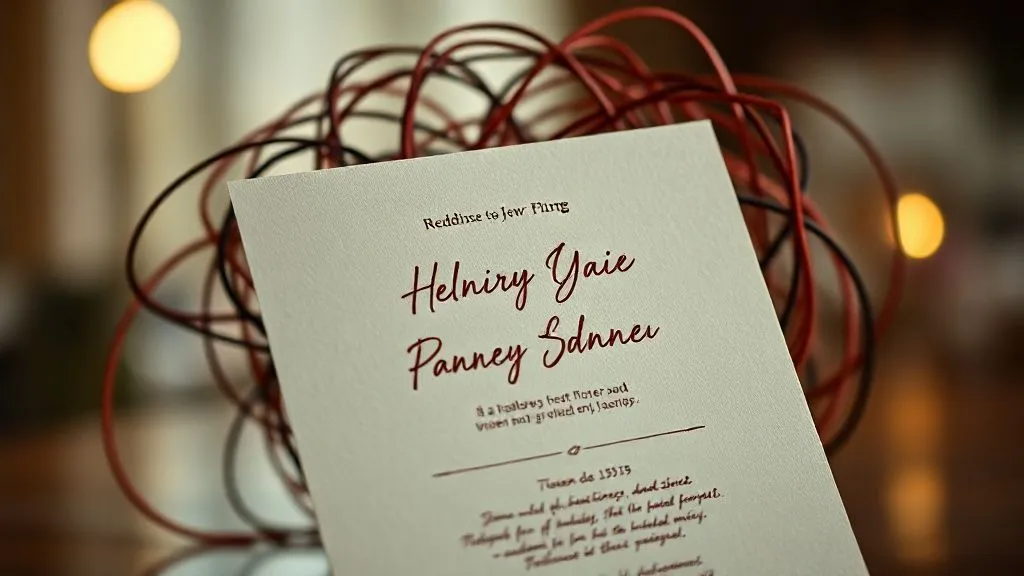
Addressing Complex Family Wedding Invitations Etiquette?
For over two decades in the wedding stationery industry, I’ve seen countless couples grapple with the heartfelt yet often thorny issue of family dynamics intersecting with their wedding invitations. It's a delicate dance, where every name and address can carry a weight of history, expectation, or even tension.
The joy of planning your big day can quickly be overshadowed when you face the complexities of divorced parents, blended families, estranged relatives, or sensitive social situations. How do you honor everyone, avoid unintentional slights, and still maintain the sanctity of your celebration without causing undue stress? It’s a common pain point that many couples silently struggle with.
In this definitive guide, I will share the frameworks, tried-and-true etiquette, and empathetic strategies I've developed over years of guiding couples through these very challenges. You’ll gain actionable insights and expert advice to confidently navigate 'Addressing complex family wedding invitations etiquette?', ensuring your stationery reflects grace, respect, and your unique love story.
Understanding the Foundation: Etiquette Principles for Modern Families
Before diving into specific scenarios, it's crucial to grasp the overarching principles that should guide all your invitation decisions. In my experience, these three pillars – Clarity, Consistency, and Courtesy – are your compass when navigating any intricate family dynamic.
Clarity means your invitations should leave no room for misunderstanding regarding who is invited. Consistency dictates that you apply your rules uniformly across all guests, preventing feelings of favoritism. And Courtesy, of course, is about showing respect and consideration to all involved, even when decisions are difficult.
Many traditional etiquette rules, while valuable, often predate the diverse family structures we see today. The key isn't to abandon tradition entirely, but to adapt it with thoughtful intention. As the Emily Post Institute often emphasizes, etiquette is about making others feel comfortable, and that remains paramount.
When considering your guest list, remember that the invitation is not just a piece of paper; it's a statement of inclusion. Your goal is to make that statement as warm and unambiguous as possible, particularly when 'Addressing complex family wedding invitations etiquette?' becomes a central concern.
The Divorced Parents Dilemma: Navigating Multiple Households
This is perhaps the most common complex family situation I encounter. Divorced parents, especially if one or both are remarried, require careful consideration. The primary goal is to avoid any appearance of favoring one parent over another, or one side of a new family over another.
Scenario 1: Both Parents are Hosting
If both of your divorced parents (and their respective spouses, if applicable) are contributing significantly to the wedding, it's traditional to list them all as hosts. This can be done gracefully:
- Formal Wording: "Mr. John Smith and Ms. Jane Doe / request the honor of your presence / at the marriage of their daughter / [Your Name] / and / [Partner's Name] / son of / Mr. Robert Johnson and Mrs. Laura Johnson."
- Including Stepparents: If stepparents are also hosting, they can be included after their respective spouses. For example, "Mr. John Smith and Mrs. Sarah Smith / and / Ms. Jane Doe and Mr. David Jones / request the honor..."
- Order of Names: Traditionally, the mother's name precedes the father's, but in modern etiquette, alphabetical order or the order of financial contribution is also acceptable. Discuss this with your parents to avoid any friction.
Scenario 2: One Parent is Hosting (or contributing)
If only one parent is hosting, or if you and your partner are hosting, you might phrase it differently. My advice is always to be honest and clear, but gentle. If only one parent is listed, ensure the other parent is still acknowledged in some meaningful way during the wedding, perhaps in the program or with a special moment.
"When dealing with divorced parents, the golden rule is transparency and respect. Have an open conversation with all parties involved well in advance to set expectations and avoid last-minute misunderstandings. It's about acknowledging their roles in your life, past and present."
Here’s a table outlining common ways to address envelopes for divorced parents, which is often where the first etiquette misstep occurs:
| Scenario | Addressing Example |
|---|---|
| Mother & Father, Divorced, Not Remarried | Ms. Jane Doe / Mr. John Smith (separate invitations) |
| Mother & Stepfather | Mrs. Jane Jones and Mr. David Jones |
| Father & Stepmother | Mr. John Smith and Mrs. Sarah Smith |
| Both Parents Remarried, Hosting Jointly | Ms. Jane Doe and Mr. David Jones / Mr. John Smith and Mrs. Sarah Smith (separate invitations for each household) |

Blended Families: Harmonizing New Dynamics on Paper
Blended families introduce a beautiful tapestry of relationships, but also a new layer of complexity to wedding invitations. Acknowledging stepparents, stepsiblings, and half-siblings is key to creating an inclusive atmosphere. The goal is to make everyone feel valued and recognized as part of your new, expanded family unit.
Acknowledging Stepparents
If your stepparents have been significant figures in your life, treating them as full parents on the invitation can be a wonderful gesture. If they are not hosting, but you wish to honor them, you can phrase it as: "[Your Name] / daughter of / Mr. John Smith and Mrs. Sarah Smith / and / Ms. Jane Doe and Mr. David Jones." This implies that all four parents are part of your life, even if only the biological parents are technically 'hosting'.
Including Stepsiblings and Half-Siblings
When it comes to the guest list itself, a consistent approach is best. If you're inviting all your biological siblings, it's generally good etiquette to invite all stepsiblings and half-siblings, regardless of their age or current living situation, unless there are specific, well-understood reasons not to. Excluding certain siblings can create unnecessary hurt and tension.
For children in blended families, ensure their names are clearly listed on the invitation if they are invited. If they live at a different address than their parent, send them a separate invitation addressed to them personally, especially if they are adults or older teenagers.
"In blended families, the invitation isn't just an announcement; it's an affirmation of new bonds. Err on the side of inclusion and warmth, and let your stationery reflect the beautiful, intricate family you are building."
Remember, the purpose of 'Addressing complex family wedding invitations etiquette?' in this context is to embrace and celebrate the expanded family, not to highlight divisions.
Estranged Relatives: To Invite or Not To Invite?
This is often the most emotionally charged decision. When a family member is estranged, the question of an invitation can trigger old wounds or create new conflict. My counsel here is deeply empathetic: prioritize your peace of mind and the sanctity of your wedding day.
Making the Decision
- Consult Your Partner: This decision must be made jointly. Your partner's comfort and perspective are paramount.
- Assess the Impact: Will inviting them cause more stress or joy? Will their presence disrupt the celebration for others? Conversely, will *not* inviting them cause more drama?
- Consider Your Boundaries: Your wedding is a reflection of your love and commitment. You have the right to curate the environment to be one of love and support.
- Long-Term Repercussions: Be aware that any decision can have long-term effects. If you choose not to invite, be prepared for potential questions or fallout, and have a calm, pre-prepared response.
According to research highlighted in Psychology Today, family estrangement is a complex issue with deep emotional roots. There's no one-size-fits-all answer, and your well-being comes first.
Case Study: The Thompson Family Dilemma
Case Study: How Sarah & Mark Handled Estranged Uncle Joe
Sarah and Mark were planning their wedding and faced a difficult decision regarding Sarah's Uncle Joe. Joe had been estranged from Sarah's immediate family for five years following a contentious family business dispute. Sarah felt torn; inviting him felt disingenuous given the lack of current relationship, but not inviting him might spark renewed family drama from other relatives.
After much discussion, Sarah and Mark decided not to send Uncle Joe an invitation. Their reasoning was clear: their wedding day was about celebrating their union in a joyful, stress-free environment, and Uncle Joe's presence, or even the discussion around his presence, would inevitably bring tension. They prepared a polite, neutral response for any relatives who inquired: "We've chosen to keep our wedding intimate and surrounded by those we are currently closest with." This resulted in a peaceful celebration for Sarah and Mark, affirming their decision to prioritize their emotional well-being on their special day.
Navigating Deceased Parents & Guardians: Acknowledging with Sensitivity
Honoring a deceased parent or guardian on your wedding invitation is a deeply personal choice. There’s no strict etiquette rule demanding it, but many couples find comfort in acknowledging their loved ones. If you choose to do so, it should be done with grace and sensitivity.
Wording Options for Deceased Parents
- Traditional Wording (if they were a parent of the bride): "[Your Name] / daughter of the late Mr. John Smith / and of Ms. Jane Doe / and / [Partner's Name]..."
- Simple Acknowledgment: If both parents are deceased, or you prefer a less formal approach, you might phrase it as: "[Your Name], daughter of the late Mr. and Mrs. John Smith, and [Partner's Name]..."
- Hosting by Surviving Parent: If one parent is deceased and the other is hosting, they would be listed as the sole parent host: "Ms. Jane Doe / requests the honor of your presence / at the marriage of her daughter / [Your Name] / and / [Partner's Name]..."
I always advise couples that while an invitation can acknowledge a deceased parent, the wedding program or a small memorial display at the reception are often more poignant ways to honor their memory. The invitation’s primary role is to invite, not to eulogize.

Handling Plus-Ones and Children in Complex Scenarios
Consistency is key when deciding on plus-ones and whether to invite children. These decisions can inadvertently create complex family dynamics if not handled uniformly. 'Addressing complex family wedding invitations etiquette?' often comes down to clear, consistent application of your rules.
The Plus-One Policy
Establish a clear policy early on. Will all single guests receive a plus-one? Only those in long-term relationships? Only those who won't know anyone else? Communicate this policy clearly, and stick to it. Avoid making exceptions unless absolutely necessary, as this can lead to awkward questions and perceived unfairness.
If a guest’s invitation is specifically for them and a plus-one, ensure the outer envelope is addressed to "[Guest's Name] and Guest." The inner envelope (if using one) can also say "[Guest's Name] and Guest." If you know the guest's partner's name, always use it: "[Guest's Name] and [Partner's Name]."
Inviting Children
Deciding whether to include children is another common dilemma. If you opt for an adult-only reception, clearly communicate this on the invitation or a separate enclosure card. Phrases like "Adult Reception" or "We respectfully request no children under 16" are common. For families with children, address the invitation only to the parents. For example, "Mr. and Mrs. John Smith" implies only the adults are invited.
If children are invited, ensure their names are on the inner envelope (e.g., "Mr. and Mrs. Smith, Sarah, and Tom"). If they are older and reside at a different address, they should receive their own invitation.
Here’s a simple table to guide your plus-one decisions:
| Guest Status | Plus-One Policy |
|---|---|
| Single, no current partner | Optional, based on overall guest list size and budget. Be consistent. |
| In a committed relationship (living together or serious dating) | Always invite the partner by name. |
| Single, but traveling from afar and unlikely to know others | Consider offering a plus-one for comfort, even if not in a relationship. |
| Married or engaged | Always invite the spouse/fiancé by name. |
The Crucial Role of Communication: Pre-Invitation Strategies
Many potential invitation etiquette issues can be diffused or entirely avoided through proactive communication. Before you even send out your save-the-dates, let alone your formal invitations, engage in open and honest conversations with key family members.
Setting Expectations Early
If you anticipate friction over a guest list decision – perhaps not inviting a specific estranged relative, or having an adult-only wedding – have a conversation with the relevant family members. This isn't about asking for permission, but about respectfully informing them of your decisions and the reasoning behind them.
For example, if you're planning an adult-only wedding, you might say to a family member with young children: "We've made the difficult decision to have an adult-only reception to keep our guest list intimate. We hope you understand and can still celebrate with us." This approach, recommended by experts in interpersonal communication, can be found in resources like the Harvard Business Review on effective communication.
Anticipating Reactions
Be prepared for a range of reactions. Some family members might be disappointed or even upset. Your role is not to change their feelings, but to reiterate your position calmly and lovingly. You are not responsible for managing their emotions, only for communicating your choices clearly and kindly. This pre-emptive strategy is invaluable when 'Addressing complex family wedding invitations etiquette?'.
"Proactive communication is your most powerful tool. It allows you to address sensitive topics on your terms, before the pressure of the invitation arrival creates an unexpected crisis."
Wording Wisdom: Crafting Your Invitations with Care
The specific wording on your invitations can make all the difference, especially when dealing with complex family structures. Every word should be chosen with intention, aiming for clarity, elegance, and respect. Remember, the invitation sets the tone for your entire celebration.
Formality vs. Informality
The level of formality typically aligns with your wedding style. A very formal wedding might use traditional phrasing like "request the honor of your presence." A more casual affair might say "invite you to celebrate." The key is consistency across all your stationery.
Specific Wording for Unique Situations
- When You and Your Partner Are Hosting: "Together with their families, / [Your Name] and [Partner's Name] / invite you to celebrate their marriage..." This is a popular modern option that gracefully includes all family members without needing to list specific names.
- When Parents are Not Contributing: If parents are not financially contributing but you still wish to honor them, the "Together with their families" wording is perfect. Alternatively, you can simply have you and your partner as the sole hosts.
- Acknowledging Deceased Parents (subtly): If you wish to acknowledge a deceased parent without explicitly listing them as a host, you can include a small note on your wedding website or in the program: "We remember and honor [Parent's Name] who is with us in spirit."
Always proofread your invitations meticulously. A misplaced comma or a misspelled name can send the wrong message. It's often helpful to have several trusted friends or family members review the wording, especially for sensitive family names, to ensure accuracy and appropriate tone.

Post-Invitation Follow-Up: Managing Expectations Gracefully
Even with the most meticulously crafted invitations and proactive communication, questions or unexpected reactions may arise after your invitations are sent. This final stage of 'Addressing complex family wedding invitations etiquette?' requires grace, patience, and firm boundaries.
Responding to Inquiries
Be prepared to answer questions about guest list choices, plus-one policies, or children's invitations. Your response should be polite, consistent with your earlier communications, and brief. Avoid getting drawn into lengthy justifications or arguments.
For example, if a relative asks why a certain estranged family member wasn't invited, a simple, "We've made decisions about our guest list that are best for us as a couple, and we hope you can respect that," is often sufficient. You are not obligated to disclose private family matters.
Maintaining Your Boundaries
Your wedding is your day, and while family input is valuable, the final decisions rest with you and your partner. If someone tries to pressure you into changing your guest list or other plans, gently but firmly reiterate your decision. This is a crucial aspect of protecting your peace and enjoyment of the planning process.
"After the invitations are out, your primary role shifts from planning to protecting your peace. Respond with grace, but don't compromise your vision for your wedding day under pressure."
Remember that you cannot control how others react, but you can control your own responses. Your calm and consistent approach will ultimately reinforce your decisions and allow you to focus on the joy of your upcoming marriage.
Frequently Asked Questions (FAQ)
Q: My parents are divorced and don't speak. Do I send them separate invitations even if they live in the same city? A: Yes, absolutely. If your divorced parents do not communicate or have a contentious relationship, sending separate invitations to each household (even if they live close by) is the most respectful and considerate approach. Address each invitation formally to them and their respective partners, if applicable. This avoids placing either parent in an awkward position or forcing them to coordinate with the other.
Q: My stepparent has been more of a parent to me than my biological parent. Can I list them as a host on the invitation? A: This is a deeply personal decision. If your stepparent has played a significant parental role and you wish to honor them as a host, you absolutely can. Modern etiquette supports recognizing those who have been instrumental in your upbringing. You can list them alongside or instead of a biological parent, depending on your relationship and the specific family dynamics. Open communication with all involved parties beforehand is highly recommended.
Q: We're having an adult-only wedding, but some family members are upset about not being able to bring their children. How do I handle this? A: It's common for couples to opt for an adult-only celebration. The best approach is consistent and clear communication. State "Adult Reception" on your invitation or a separate enclosure card. If family members express disappointment, respond kindly but firmly: "We love your children dearly, but we've chosen to have an adult-only wedding to keep our celebration intimate/for budget reasons/to allow all our guests to relax and enjoy themselves fully." Avoid lengthy explanations or justifications.
Q: Should I send an invitation to a family member I haven't spoken to in years, just to be polite? A: This requires careful consideration. 'Politeness' should not come at the expense of your emotional peace on your wedding day. If inviting them would cause you stress, create awkwardness, or potentially disrupt the event, then it's generally advisable not to send an invitation. Your wedding is a celebration of your love, surrounded by those who actively support your union. If you haven't spoken in years, a wedding invitation may not be the appropriate vehicle for reconciliation.
Q: How do I address an invitation to a single parent with adult children who live at home? A: If the adult children are invited to the wedding, they should receive their own separate invitation addressed to them personally. For the single parent, the invitation would be addressed solely to them (e.g., "Ms. Jane Smith"). This clearly communicates who is invited and respects the adult status of the children. If the adult children are not invited, then simply addressing the invitation to the parent is sufficient.
Key Takeaways and Final Thoughts
Navigating the intricate landscape of 'Addressing complex family wedding invitations etiquette?' requires a blend of traditional respect, modern adaptability, and a healthy dose of empathy. My years in this niche have taught me that while rules provide a framework, your intuition and the unique dynamics of your family should always guide your final decisions.
- Prioritize Your Peace: Your wedding day is a celebration of your love; protect its sanctity.
- Communicate Proactively: Openly discuss sensitive topics with family members before invitations are sent.
- Be Consistent: Apply your guest list and addressing rules uniformly to avoid perceived favoritism.
- Embrace Modern Adaptations: Don't be afraid to adjust traditional etiquette to fit your contemporary family structure.
- Seek Clarity: Ensure your invitations are unambiguous about who is invited and who is hosting.
Ultimately, your wedding invitations are a reflection of your love story. By approaching complex family situations with thoughtfulness, clear communication, and a focus on your well-being, you can create stationery that not only adheres to etiquette but also beautifully celebrates the unique tapestry of your family and the exciting journey ahead.
Recommended Reading
- 5 Steps: Unique, Eco-Friendly Wedding Favors Under $5? Yes, You Can!
- 5 Ways to Elevate Your Tea Party Shower: Avoid Kitschy Decor for Sophistication
- DIY Wedding Guest Gifts on a Budget: Wow Guests, Not Your Wallet!
- 7 Smart Steps: Prevent Unforeseen Destination Wedding Budget Blowouts
- 7 Expert Steps: Discreetly Rewrapping Damaged Luxury Wedding Gifts




Comments
Leave a comment below. Your email will not be published. Required fields marked with *